store@seahomeschoolers.com
The Critical Thinker’s Toolkit
Foundations of Critical Thinking
Making the invisible work of thinking visible, so learners can apply it beyond the lesson.
In the media-rich world our children are growing up in,
critical thinking skills are essential learning.

The Critical Thinker’s Toolkit for Early childhood


The Critical Thinker’s Toolkit Level 1


The Critical Thinker’s Toolkit Level 2
Critical thinking is a set of specific skills that can be taught directly, named, practiced, and built into how a learner thinks. The research on explicit, skills-based instruction is clear on this, and it is the foundation every course in the series rests on. What is less obvious, and what shaped every decision in these three courses, is how the same skill requires a different teaching approach at three years old, at seven years old, and at twelve. This is because the cognitive operation the learner can actually perform changes as they grow.
In early childhood, a learner consolidates thinking through return. They need repeated lived encounters with the same idea in different contexts and the same vocabulary used the same way across weeks and months, until the concept becomes part of how they see the world.
A grade-school learner is becoming aware of their own thinking as something they can name and recognize. The work at this age is explicit. The educator names the skill, models it, does it together with the learner, and then hands it over. The learner catches the skill happening in the moment, in their own thinking and in the thinking of others.
A middle school learner can deploy a thinking strategy on purpose, watch whether it is working, switch when it isn’t, and construct reasoning others can examine. The work at this age is application and construction.
Each of these is a different cognitive job. A young child is building schema through return. A grade-school child is recognizing and naming. A middle schooler is deploying, monitoring, constructing, and communicating. The three courses in the series are architected around what is developmentally appropriate for each of these learners.
Early Childhood
Explicit and Play-Based Critical Thinking Instruction
This course is for learners ages 3-6
The Early Childhood course is a synthesis of phenomenon-based learning from Finnish early childhood pedagogy and explicit, skills-based instruction. The phenomenon-based side treats curiosity as the engine of learning and refuses the binary between real and pretend. The floor can be a floor and lava at the same time, and helping a young learner hold both worlds simultaneously is the conceptual foundation for thinking critically about media. The explicit side names each skill, defines it, and uses the same words for it across weeks and months, because that consistency is how a three-to-six-year-old’s schema gets built.
Every activity has two differentiated blocks, one for ages 3–4 and one for ages 5–6, because a four-year-old and a six-year-old are doing real thinking at different depths of abstraction, and the course is designed to serve the entire age range.
After each lesson, a Making the Skills Part of Every Day guide gives the educator phrases to drop into walks, breakfast tables, and the middle of play. The course assumes return, because most learners need two to four weeks with each idea before it becomes part of how they think.
A learner finishes this course with the habit of noticing already woven into how they live, and ten foundational thinking skills they have encountered through movement and play, their picture books, and their daily life.
Level 1
Noticing Your Thinking and Using It with Intention
This course is for learners in grades 1-4.
Level 1 sits at the developmental moment when learners are becoming aware of their own thinking as something they have access to. The work of the course is making that thinking visible. The learner names each skill, recognizes it in the moment, and begins to use the vocabulary in everyday life. The structure is explicit instruction inside a gradual release of responsibility, based on the explicit-instruction pattern that research supports for skill acquisition at this age.
Every lesson uses a picture book, a film, a game, and a student workbook, because at this age the same skill encountered in multiple contexts is what makes it transfer beyond the page. The picture books and films are chosen to teach the specific skill of each lesson. The games practice the skill in a low-pressure context.
The workbook includes vocabulary review, consumables, and paired worksheets to reinforce learning. It also contains an optional section called Writing about Thinking that is written to pair with The Writer’s Toolkit. Writing about Thinking is built on Hochman Method / Writing Revolution principles. This approach holds that writing is best taught explicitly through a dedicated writing program and then practiced inside the content of other subjects, where the writing work and the subject-area learning reinforce each other. Writing about Thinking is where a learner uses what they have built in The Writer’s Toolkit to write about the critical thinking skill of each lesson.
The course teaches eleven skills: metacognition, the difference between knowing and believing, recognizing assumptions, confirmation bias, fact and interpretation, the testing cycle, cause and effect, evidence, perspective, persuasion, and media literacy. Each skill builds on the ones before it, and by the eleventh lesson every skill is in use together.
A learner finishes Level 1 able to name and recognize eleven critical thinking skills, catch their own thinking in the moment, and use the skills in their own lives.
Level 2
Reasoning, Evidence, and Communication
This course is for middle school learners.
Level 2 is built around the cognition of a middle school learner. They can choose a thinking strategy on purpose, monitor whether it is working, switch when it isn’t, and build reasoning that others can examine. The course teaches deployment, monitoring, construction, and communication of thinking. The learner uses each skill on purpose, holds themselves accountable for the reasoning they build, and learns to communicate that reasoning so others can engage with it.
Teaching is distributed across the teaching guide and the student workbook. Every lesson in the workbook contains a substantial original short story in which characters work through the lesson’s skill in dialogue, modeling the skill in action and showing what it looks like to use the skill in a real situation. The workbook stories do primary teaching, not just practice. They are written for middle school readers and are paced as real stories, with developed characters, stakes the learner will recognize from their own life, and the skill embedded in how the characters reason their way through. The workbook also includes story questions, application activities, weekly practice tools, and challenge questions for learners who want to push further.
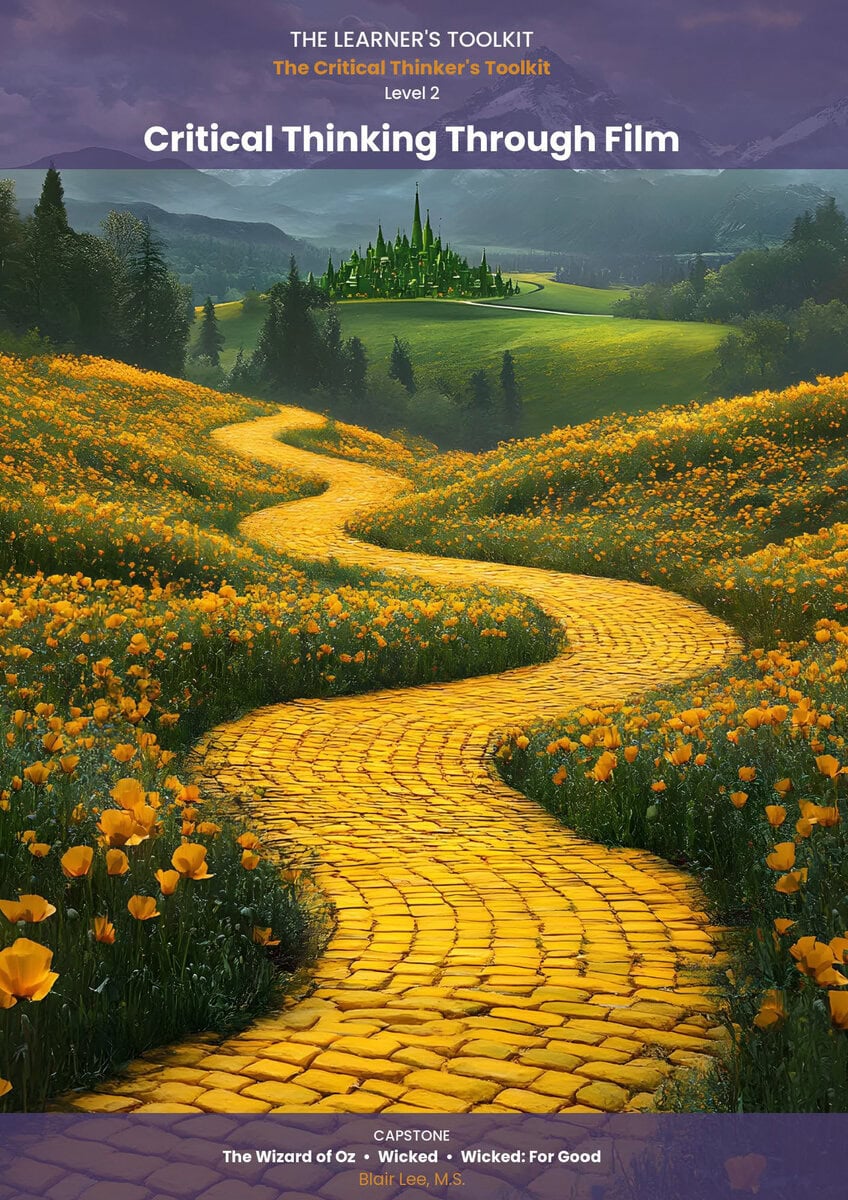
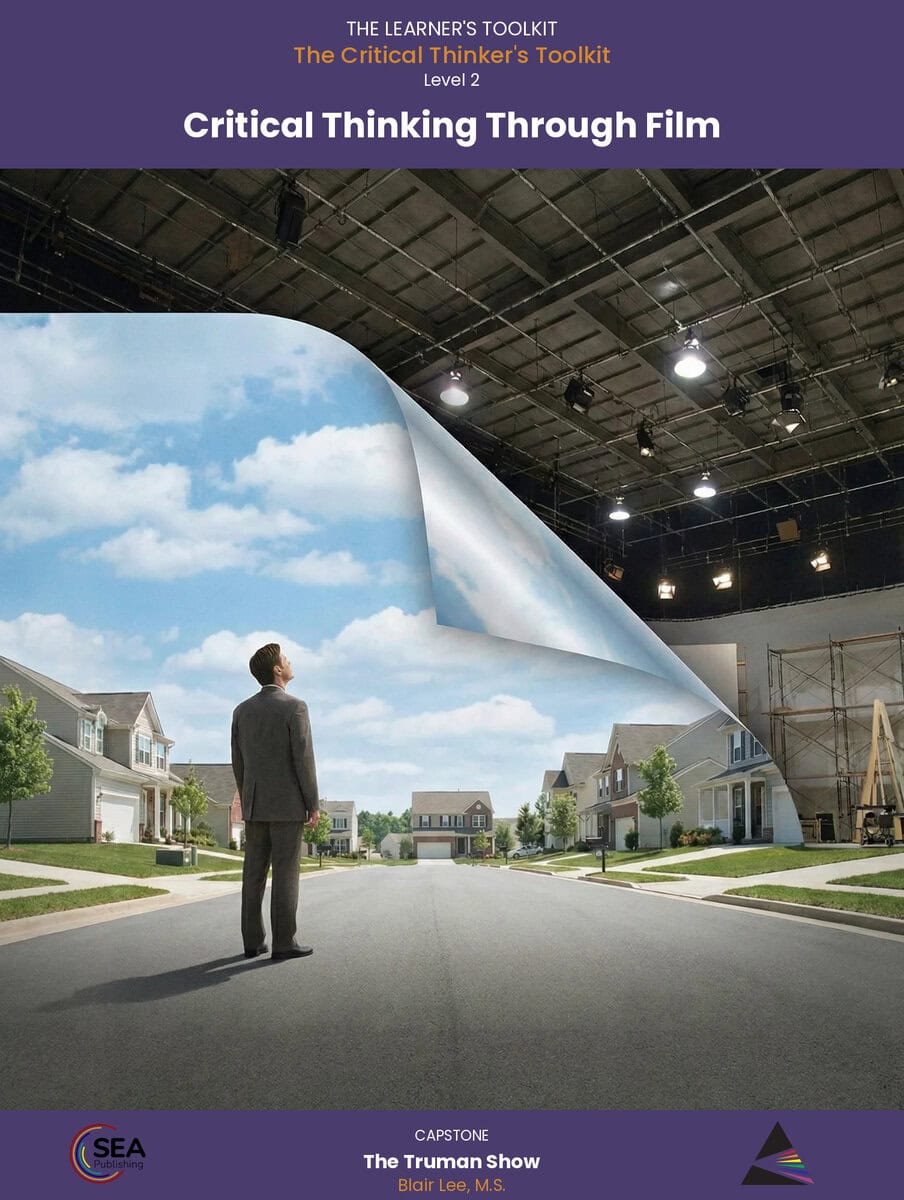
Level 2 is anchored by three film capstones: The Truman Show, The Wizard of Oz with Wicked and Wicked: For Good, and Zootopia. Each capstone is a sustained piece of work in which every skill in the course operates on a single complex film. The capstones are where eleven lessons of critical thinking become the way the learner watches, listens to, and engages with the world. A learner finishes Level 2 with reasoning they can construct, defend, and revise, and with the habit of thinking with purpose.
How the courses fit together
Every skill from a previous course is taught in every higher course. Some skills keep their own standalone lesson, and others get incorporated into a different lesson when that organization fits the learner’s developmental moment better. New skills are added at each level as the learner becomes ready for them. The skill set grows as the learner grows, and the way the skills are organized changes to match what each age can carry.
A learner who comes through the series gets compounding benefits. Each course is also complete on its own. A family starting fresh at Level 1 gets a full grade 1–4 critical thinking course, designed for that age, with everything the learner needs. A family starting at Level 2 gets a full middle school course. A family with a young learner gets a full early childhood course. Developmental fit is the only thing that matters.
Which course is right for your learner
If you are wondering which course is the best fit, each course’s product page includes samples. Reading a few pages of the actual course is the best way to know whether the level matches your learner. Please, reach out with any questions you have.
Explore more from The Learner’s Toolkit