 store@seahomeschoolers.com
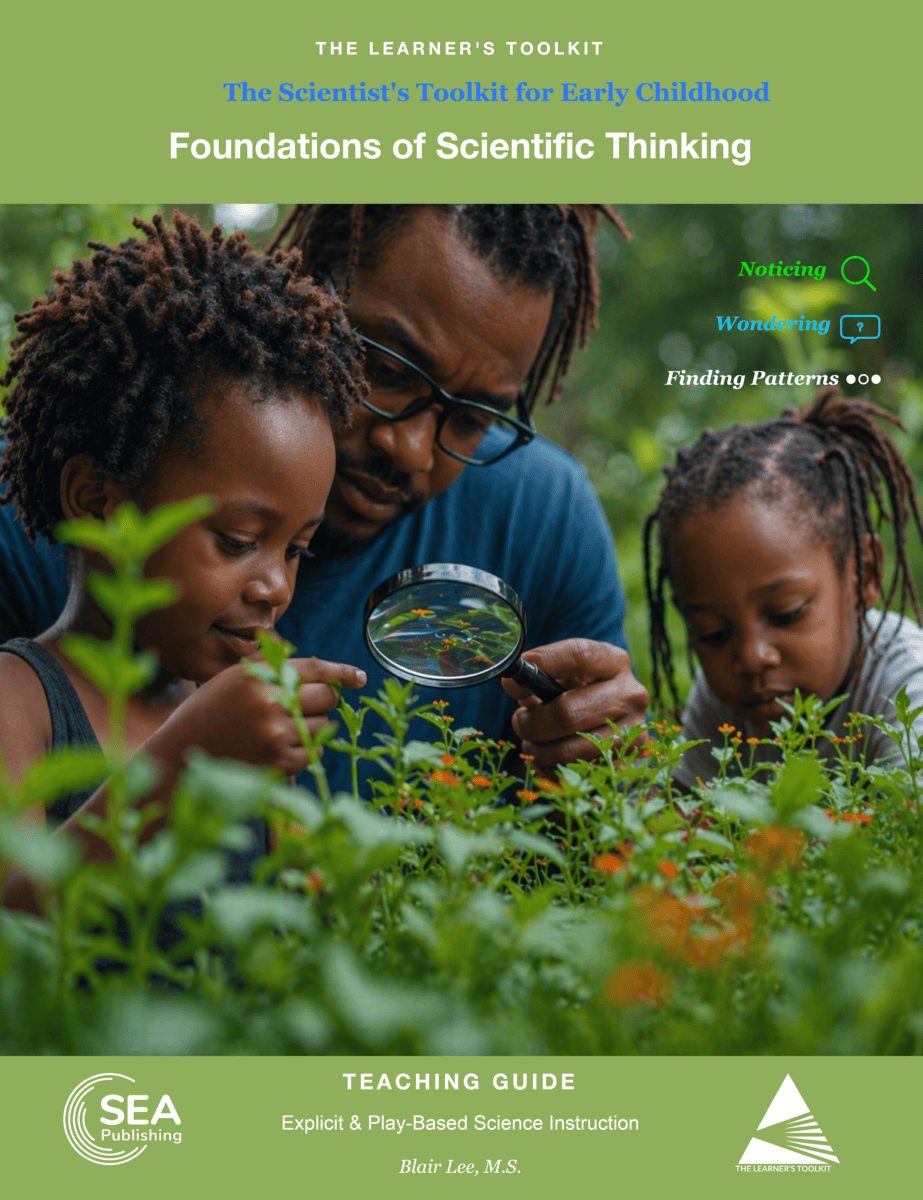
The Scientist’s Toolkit for Early Childhood
Price range: $25.00 through $42.00
The Scientist’s Toolkit for Early Childhood is a ten-lesson science course for children ages 3–6 that builds the real skills scientists use: observation, classification, comparison, prediction, measurement, cause and effect, evidence-based reasoning, and designing an investigation. Each lesson introduces one skill through phenomenon-based learning . Your child encounters the natural world first, then names what they are doing. No worksheets. No memorization. Just genuine science thinking, built one skill at a time, in the living world around you. Written for children who are ready to think like scientists before they can read.
NOTE: The PDF Teaching Guide is READ-ONLY. It is not printable. For a print version of the guide you need to purchase the print version of the course.
The Scientist's Toolkit for Early Childhood is a complete ten-lesson Teaching Guide for ages 3–6, designed for homeschool families and co-ops. It is the foundational science tier of The Scientist's Toolkit series, sitting below the elementary, middle school, and high school levels and feeding directly into them.
What this course is built on
This course was developed at the intersection of two educational frameworks. Finnish phenomenon-based learning treats the young learner as a capable scientist from age three, centers inquiry and direct encounter with the natural world as foundational, and uses what the child observes and questions as the engine of learning. The Hochman Method of explicit instruction holds that skills are not absorbed passively: they are named, defined, taught directly, practiced deliberately, and returned to repeatedly until they become habit. The result is a curriculum that is both scientifically rigorous and deeply age-appropriate.
Finland begins teaching science as a thinking practice at age three on purpose. Young children are already asking questions about the living world around them -- why things sink, what caused that sound, where roly polies prefer to be. This course meets those questions with the explicit instructional structure that homeschool families know and trust, and with the scientific vocabulary and methods those questions deserve.
What the course covers
Ten lessons, each targeting one foundational science skill:
Lesson 1: Observation. Learners are introduced to looking carefully and using what they observe as the starting point for all scientific thinking.
Lesson 2: Classification. Learners practice sorting the living world into groups based on evidence they can see.
Lesson 3: Comparison. Learners practice identifying what is the same and what is different, and using comparison as a tool for understanding living and non-living things.
Lesson 4: Change Over Time. Learners observe that living things change, that change follows patterns, and that scientists track those patterns carefully.
Lesson 5: Prediction. Learners practice using what they already know as evidence for what they think will happen next.
Lesson 6: Measurement. Learners discover that careful observation requires tools, and that measurement is how scientists make their observations trustworthy.
Lesson 7: Cause and Effect. Learners practice finding what made something happen and what happened because of it.
Lesson 8: Evidence-Based Reasoning. Learners practice using what they observe to support what they think, and learn that a claim without evidence is just a guess.
Lesson 9: Designing an Investigation. Learners design their own fair tests -- forming a hypothesis, planning, carrying out, observing, and saying what the evidence tells them.
Lesson 10: Stewardship. Learners connect everything they have learned to the living world they are part of, and earn the identity that makes it meaningful: planet protector.
What each lesson contains
Every lesson follows the same structure. A Read Aloud opens the lesson and introduces the skill by name, defining the concept in age-appropriate language and connecting it to the previous lesson. Hands-on activities follow, each building on the skill through direct encounter with the natural world. A Making the Skills Part of Every Day guide closes each lesson with language for extending the skill into everyday moments. Every lesson includes scripted Say and Ask prompts throughout every activity, making the curriculum accessible for parents new to explicit instruction and consistent across educators in co-op and microschool settings. Teaching Notes address the parent or educator directly before each activity, providing the pedagogical reasoning behind it and flagging what to watch for. Differentiation blocks for Ages 3--4 and 5--6 appear at the end of every activity, so the same lesson serves the full age range without requiring separate preparation.
What you get
One Teaching Guide covering all ten lessons. No student workbook at this level: the curriculum is oral, hands-on, and read-aloud based. Picture books are listed per lesson and available through libraries or standard retail.
Designed for homeschool families, microschools, and co-ops. No worksheets. No drills. Explicit, sequential, skills-based instruction delivered through direct encounter with the living world.
By the time your child is six, they will not just love nature. They will have the tools to think about it like a scientist.
Book List
Lesson 1: Bees, Snails and Peacock Tails by Betsy Franco
Lesson 2: Who Am I? by Robin Page and Steve Jenkins
Lesson 3: Actual Size or Prehistoric Actual Size by Steve Jenkins
Lesson 4: Waiting for Wings by Lois Ehlert
Lesson 5: Who Sank the Boat? by Pamela Allen
Lesson 6: How Big Is a Foot? by Rolf Myller; How Tall? by Igor Sinkovec
Lesson 7: Because of an Acorn by Lola M. Schaefer
Lesson 8: Whose House Is That? by Stan Tekiela
Lesson 9: Cece Loves Science by Kimberly Derting and Shelli R. Johannes
Lesson 10: The Other Way to Listen by Byrd Baylor; Water Protector by Carole Lindstrom
Additional information
| Weight | 0.5 lbs |
|---|---|
| Format | E-Book, Print |

Reviews
There are no reviews yet.