 store@seahomeschoolers.com
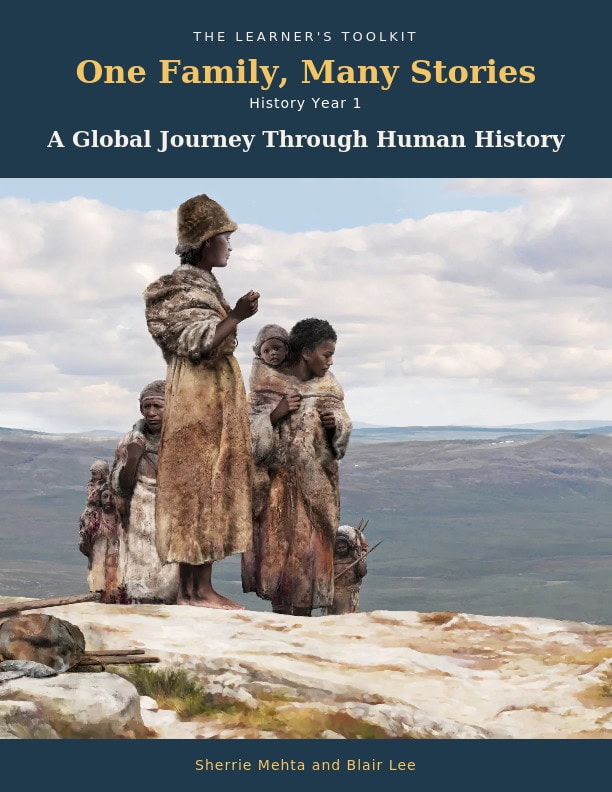
The Historian’s Toolkit – Level 1
Coming Soon!
One Family, Many Stories is a secular, global Grade 1–2 history program that follows the journey of the entire human family—from your learner’s own family stories to early humans, worldwide migrations, Indigenous innovations, and the rise of early civilizations. Through storytelling, hands-on activities, maps, artifacts, and identity-focused reflection, children learn that history is the story of all people—and that they are part of it.
A gentle, story-rich introduction to world history that begins with the learner and expands outward to the whole human family.
One Family, Many Stories is a fully secular, developmentally aligned Grade 1–2 history curriculum that helps young learners make sense of the past through storytelling, hands-on exploration, and global perspectives.
Children begin with their own family stories—the history they already carry—and gradually journey backwards through time to meet early human ancestors, follow ancient migrations across continents, and explore the innovations of the world’s first farmers, navigators, builders, artists, and city-makers.
This course teaches history the way young children learn best: with narrative, imagination, concrete activities, and powerful visuals such as the Human Family Tree and the Time Travel Passport. Each lesson roots children in evidence-based thinking by pairing story, mapping, artifacts, and guided reflection with clear, age-appropriate scientific understanding.
A Global, Inclusive Story
Children travel from Africa (the origin of all humans), to Asia, Australia, Europe, the Arctic, the Americas, and the Pacific Islands—meeting diverse ancestral families and seeing how people everywhere adapted creatively to their environments.
Every region of the world is shown as a center of innovation:
- African fire keepers, artists, and herders
- Asian river farmers and monsoon adaptors
- Australian navigators and land stewards
- Arctic and Siberian innovators
- Indigenous Americans domesticating plants and shaping landscapes
- Pacific Islanders mastering star navigation
- Early city builders in the Indus Valley, Mesopotamia, Egypt, and the Mississippi Valley
Why It Matters
Children learn that:
- All humans share a common African beginning
- Every culture contributed to human knowledge
- Families everywhere solved problems with creativity and intelligence
- Their own family’s story is part of something vast and beautiful
This curriculum builds historical understanding without mythologizing, moralizing, or centering one region of the world. Instead, it introduces young learners to a shared human story filled with resilience, innovation, and connection.
What Makes This Program Different
1. A History Program Grounded in Identity and Evidence
The course begins with the learner’s own family stories and teaches children how historians use artifacts, imagination, and evidence to understand the past.
2. Story-Led but Scientifically Accurate
The narrative is warm, engaging, and child-centered—but rigorously aligned with archaeology, anthropology, and current human-origins science. Lessons include Lucy, Homo habilis, Homo erectus, Neanderthals, Homo sapiens, migrations, climate shifts, land bridges, the domestication of wolves, and ancient innovations—all taught through developmentally appropriate storytelling.
3. A Fully Global Arc (No Eurocentrism)
Every continent appears.
Every region is shown as innovative.
Every child sees their family in the story.
4. Multimodal Learning
Each lesson includes:
- Read-aloud narrative
- Hands-on science/history activities
- Mapping
- Nature and artifact exploration
- Identity connections
- Writing Prompts based on the Hochman Method
What's Included
Teacher Guide
A full year of scripted lessons (32 lessons), each with:
- Story-based read-aloud
- Discussion prompts
- TWTk metacognitive routine
- Activity Day 1 (science/history grounded)
- Activity Day 2 (creative, applied, or mapping)
- Passport Stamp & Human Family Tree updates
Student Materials
- Time Travel Passport
- Human Family Tree
- Region maps
- Artifact activity templates
- Time Capsules & Story Cards
- Mapping pages
Teacher Supplements
- Booklist (picture books for each unit)
- Supply lists by week
- Suggested modifications for multi-age families
Skills Developed
- Historical reasoning
- Evidence-based thinking
- Sequence & timeline awareness
- Cultural empathy & identity development
- Geographic literacy
- Early anthropology & earth science concepts
- Observation & inference
- Narrative understanding
Pedagogy Tags
- Global History
- Identity-Based Learning
- Inquiry-Based Learning
- Evidence-Based Thinking
- Mapping & Geography
- Storytelling Pedagogy
- Early Elementary Curriculum
- Multimodal Instruction
- Cognitive Load–Aware Teaching
- Secular Curriculum
- Anti-Bias Education
Foundational Anthropology
Additional information
| Weight | 0.5 lbs |
|---|---|
| Format | E-Book, Print |
You may also like…
-
Sale!

Microbiology
Price range: $75.00 through $115.00 -

REAL Science Odyssey – Earth & Environment 2 textbook
$89.99 -

The Science of Climate Change: A Hands-On Course
$24.95 -
Sale!

Project-Based Learning: Creating a Modern Education of Curiosity Innovation & Impact – Print
Original price was: $51.98.$37.99Current price is: $37.99. -

R.E.A.L. Science Odyssey Biology 2
$89.99 -

6th Grade Complete Language Arts Bundle
$30.00

Reviews
There are no reviews yet.