store@seahomeschoolers.com
The Historian’s Toolkit
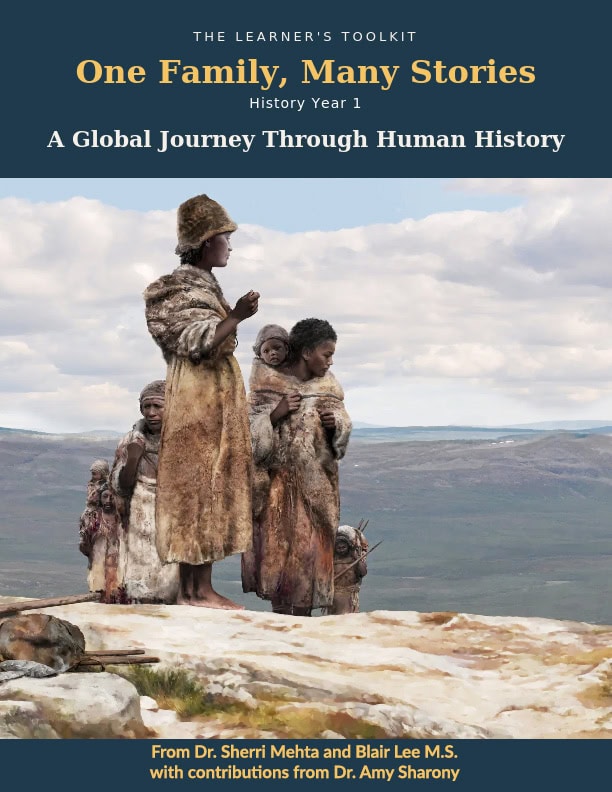
One Family, Many Stories
A Global Journey Through Human History
History Year 1 ~ Deep History
The Historian’s Toolkit Year 1 Audiobook
The Historian’s Toolkit, History Year 1 — part of The Learner’s Toolkit from Dr. Sherri Mehta and Blair Lee, M.S. with contributions from Dr. Amy Sharony
One Family, Many Stories is a read-aloud history course that carries your learner through deep history, the long human past before written records, from the walking ancestors of more than three million years ago to the eel farmers of southern Australia 6,600 years ago. A single Time Traveler makes thirty-four stops across six continents. Each lesson opens the same way: Your learner touches the Time Travel Passport, closes their eyes, and opens them somewhere new, standing on a grassland in East Africa, on a rocky South African shore, on the flooding shores of western Canada. The frame gives a young learner one steady anchor to cross enormous distances of time and place, so a leap of a hundred thousand years feels like the next step in a single story.
The history is grounded in real science and archaeology, and the course is fully secular. Every lesson rests on actual fossils, footprints, tools, shell heaps, and excavated sites. Using guides, scenes, and real ecological and anthropological data, your learner steps inside real stories. They watch Lucy’s family walk upright through the grass and climb the trees for safety, distant relatives who walked the Earth long before our own kind appeared, close cousins rather than members of our own genus. The course follows that whole wider family: The walking cousins like Lucy, the first toolmakers like Homo habilis, Homo erectus fire keepers who carried fire out of Africa, and the Neanderthals and other early humans who once shared the planet, until your learner meets Homo sapiens in Africa at the advent of their evolution and learns that for a long time we were just one branch of human among several. They crouch at the tide pools at Blombos while a woman threads shell beads by firelight. They walk with a hunter-gatherer family reading the land, antelope tracks in the dust, birds flying toward water at dusk, and meet a lake family who stay in one place because the lake gives them what they need. The children who guide each lesson carry the history through what they do and say. When the traveling girl tells you “the lake people’s way is good for them, our way is good for us, there are many ways to be a hunter-gatherer,” she is teaching the heart of the course in her own voice.
That idea runs the whole way through. Every way of living your learner meets is shown as a wise and complete answer to one question: How do we make a home in this place? The Natufian grandmother watching wheat grow where seeds had spilled. The Andean family freezing potatoes night after night into chuño that lasts for years. The Gunditjmara child checking the eel traps in channels a great-great-grandmother helped build, on Country her people have tended and belonged to for thousands of years and tend still. None of these is a rung on a ladder climbing toward something better. Each is a home.
Climate is the thread that ties the journey together. A drying Africa sends families walking. An Ice Age teaches them to outlast the cold. A warming world raises the seas, drowns the land bridge of Doggerland and Japan, and opens forests where ice used to be. Following that thread, your learner also sees how good ideas move through the world, invented over again by people who never met, as farming was invented in the Fertile Crescent, China, and the Americas. And throughout, the course lets your learner in on how anyone could know these things at all, reasoning from the bones, the footprints in old ash, the shell heaps, the stone walls still standing, the way the people who study the past actually do.
Skills your learner builds
Historical reasoning and evidence-based thinking. A sense of sequence and deep time. Geographic literacy across six continents. Observation and inference. Early exposure to the ideas of archaeology and anthropology. Cumulative sentence-writing skill, built lesson by lesson through the Writing in History strand. And a grounded sense of identity: that their own family’s story is the first piece of history, and part of one shared human story.
At a glance
Elementary Level · Read-aloud · Secular · Deep history and human origins (spans from 3.2 million years ago – 6,600 years ago) · Global, every-continent scope · Evidence-based and archaeology-grounded · Hands-on and multimodal · Cumulative writing instruction · Anti-bias, many-ways-to-live framing
Explore more from The Learner’s Toolkit