 store@seahomeschoolers.com
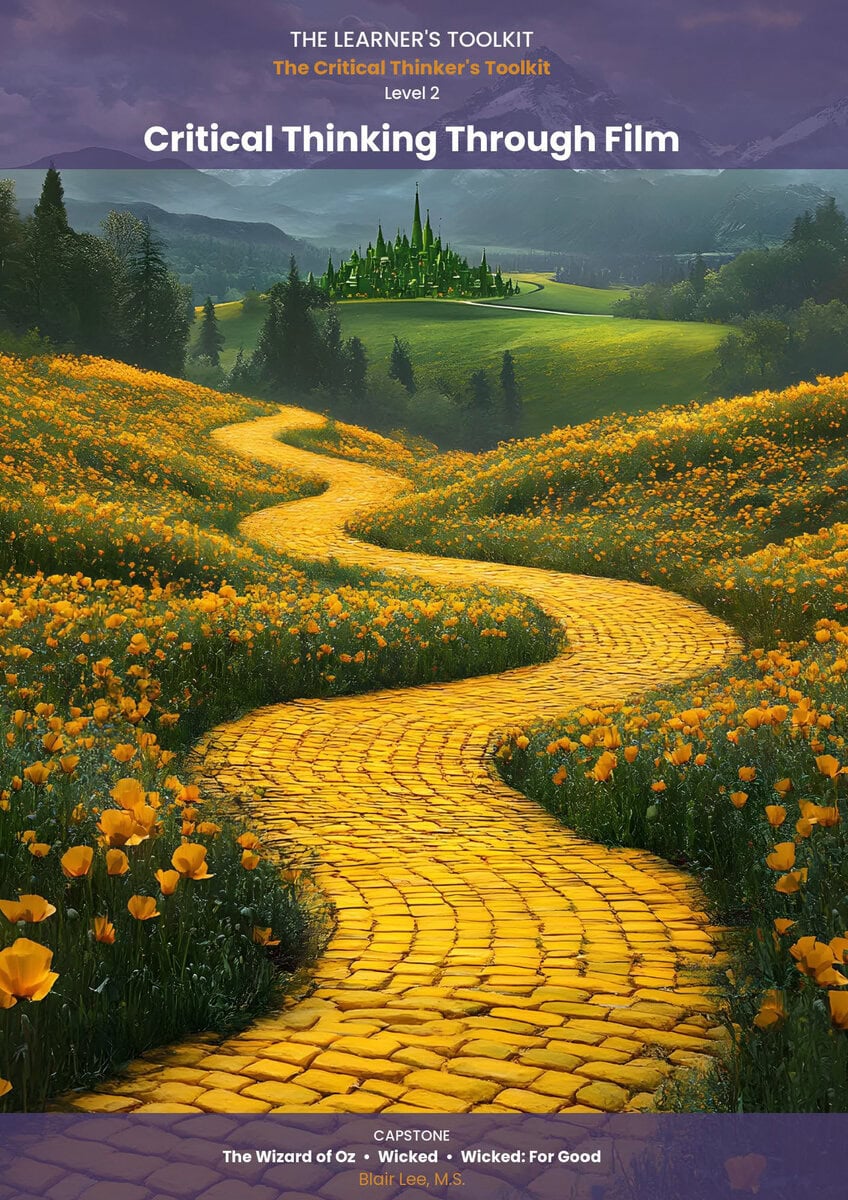
Critical Thinking Through Film – Oz/Wicked
$20.00
Critical Thinking Through Film – Oz / Wicked is a structured capstone mini-unit for middle school learners that teaches students to evaluate evidence, test assumptions, analyze perspective, and revise conclusions as new information emerges. Using three films that tell the same story from conflicting viewpoints, learners apply essential critical thinking tools in an authentic, high-interest context.
This capstone is included with The Critical Thinker’s Toolkit Level 2 and may also be used as a standalone unit. This is not a discussion guide. It is critical thinking in action.
This film-based capstone mini-unit is designed to answer a single, essential question:
Can learners actually use critical thinking tools when stories are emotionally compelling and socially familiar?
Rather than asking students to analyze themes or share opinions, this capstone requires them to apply explicit critical thinking skills to three interconnected films that tell the same story from radically different perspectives.
Across The Wizard of Oz, Wicked, and Wicked: For Good, learners form initial conclusions, encounter conflicting evidence, revise their thinking, and ultimately synthesize a reasoned position—mirroring how strong thinkers operate in real life.
How the Capstone Works
This unit is intentionally structured around the Testing Cycle:
- The Wizard of Oz → Observe and Infer
Learners analyze how labels, authority, aesthetics, and storytelling shape belief. They form an initial hypothesis about characters, motives, and morality. - Wicked → Test and Revise
New information challenges earlier conclusions. Learners must decide whether their original reasoning holds up or requires revision. - Wicked: For Good → Synthesize and Demonstrate
Learners integrate all available evidence, acknowledge uncertainty, and construct a final, well-reasoned position.
The goal is not to reach a “correct” interpretation—but to demonstrate disciplined thinking under pressure.
Critical Thinking Skills Applied
Throughout the capstone, learners actively practice:
- Evaluating evidence quality rather than trusting authority or emotion
- Separating fact from interpretation
- Identifying hidden assumptions installed by stories and aesthetics
- Testing causal claims for real mechanisms
- Recognizing persuasive techniques and narrative manipulation
- Mapping perspective and bias without falling into false equivalence
- Building and revising reasoning chains
- Acknowledging uncertainty as part of intellectual honesty
Each task requires learners to show their thinking, not just state conclusions.
What Makes This Capstone Different
Most film-based units focus on discussion, theme identification, or moral reflection.
This capstone is different.
- Every task includes a fully worked example showing how to use the thinking tool
- Learners are guided step by step from observation to conclusion
- Emotional engagement is treated as something to be examined—not indulged
- Perspective-taking is taught with guardrails, explicitly addressing false equivalence
A critical meta-layer asks learners to reflect on a central danger:
Am I thinking critically—or just replacing one story with a more appealing one?
This prevents narrative swapping and builds genuine intellectual discipline.
What’s Included
- Student Workbook
- Structured tasks for all three films
- Fully worked examples for every critical thinking tool
- Culminating synthesis tasks that demonstrate skill transfer
- Teaching Guide
- Scene-based discussion prompts
- Clear skill alignment to critical thinking tools
- Sample responses and pacing guidance
- Designed for home educators and small groups
The Student Workbook and Teaching Guide are designed to work together as a complete instructional experience.
How This Unit Can Be Used
- As the culminating capstone for The Critical Thinker’s Toolkit – Level 2
- As a standalone critical thinking mini-course
- In homeschool, co-op, enrichment, or discussion-based learning environments
No prior coursework is required. Learners new to the toolkit learn each skill through the worked examples embedded in the workbook.
What Learners Gain
By the end of this capstone, learners can:
- Explain why they believe something—not just what they believe
- Revise conclusions when evidence changes
- Recognize how stories influence judgment
- Hold complexity without collapsing into relativism
- Apply critical thinking skills beyond film, school, or curriculum
This is practice for real-world thinking, not literary performance.
Pedagogy & Approach
(Learner’s Toolkit standard)
- Explicit Instruction
- Skills-Based Critical Thinking
- Evidence-Centered Reasoning
- Cognitive Load–Aware Teaching
- Developmentally Appropriate Practice
- Transfer-Focused Design
This Course Is a Great Fit If You:
- Want clear guidance for teaching complex thinking skills
- Appreciate structured discussion prompts
- Value depth over speed
- Prefer reduced planning and decision fatigue
- Want confidence that essential reasoning moves are not being missed
This Course May Not Be the Best Fit If You:
- Prefer completely open-ended discussion with minimal structure
- Want a primarily self-directed, reading-based course
- Strongly dislike scripted instructional language
- That said, many experienced educators choose scripted courses for their clarity and rigor, adapting the scripts to their own voice.
This capstone is included with purchase of The Critical Thinker’s Toolkit Level 2 and functions as Lesson 12 of the course. It may also be purchased on its own and used as a complete standalone unit; all tasks include worked examples that teach the required thinking tools within the context of the films, so no prior materials are required.
Additional information
| Weight | 0.5 lbs |
|---|---|
| Format | E-Book, Print |
1 review for Critical Thinking Through Film – Oz/Wicked
You may also like…
-

Marine Science
Price range: $108.00 through $154.00 -

Microbiology
Price range: $96.00 through $148.00 -

Critical Thinking Through Current Events – Minneapolis January 2026
$0.00 -
Critical Thinking Through Film – The Truman Show
$10.00 -
The Critical Thinker’s Toolkit – Level 2
Price range: $74.00 through $115.00 -
Critical Thinking Through Film – K-Pop Demon Hunters
$10.00




Jen Myers (verified owner) –
In a world full of conflicting narratives, it is more important than ever for students to learn how to think critically for themselves.
Critical Thinking Through Film – Oz/Wicked is one of the most well-designed critical-thinking curricula. After viewing each film, learners are guided to examine assumptions, compare ideas with evidence, and reflect on how new information shapes understanding.
The teacher’s guide is clear and easy to use. I love that it provided detailed prompts without feeling rigid. It would be an excellent fit for someone seeking a discussion-based, shared-learning experience. It is adaptable for family learning, co-ops, or classroom settings that include kids ranging from upper elementary through high school.
What I loved most about this unit study was how it encouraged deep, analytical conversation and helped learners think for themselves by questioning assumptions and examining evidence, while also connecting those skills to real-world examples.