
Why the Word Prehistory Is a Problem
There has been some back-and-forth in the group lately about the word “prehistory.” I thought I would share why the label is controversial, because we are an academic group, and as academics we tend to be picky about word usage.
I will admit that, although we have been researching the human past from about 3.2 million years ago to 6,500 years ago for more than a year while writing a new history course, I was genuinely surprised when someone in the SEA Community asked how “deep history” compares to “prehistory.” Not because I had never heard the term, but because I could not remember encountering it in the research itself. The scholarship we relied on was organized around archaeological sites, species, technologies, migrations, climate, genetics, dating methods, and particular historical questions.
What “Prehistory” Actually Means
The question made me curious enough to dig into the word itself. What I found was not a new argument. The question has been debated in the field for more than fifty years, and we are joining a conversation that was well underway long before it reached our group. Let me also say that I understand that when most people use “prehistory,” they simply mean “before written records.” That does not mean they are endorsing the history behind the term. However, that history is problematic.
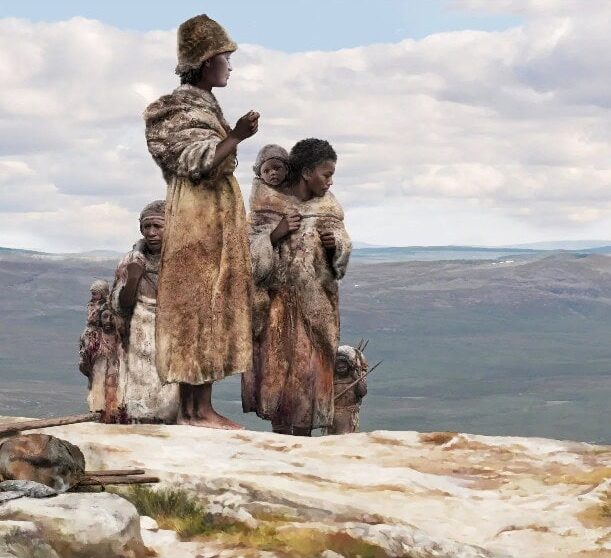
Where the Word Came From
The word grew out of nineteenth-century European scholarship, when historians increasingly defined their discipline around written documents. That created a problem: what should they call the millions of years of human history before writing? The answer became “prehistory,” which literally means “before history.” By its very definition, the label carries an assumption: that history begins when writing begins.
The Ladder Nineteenth-Century Scholars Built
That assumption is pervasive, and it is pernicious. It leads to biases that run through the labels and adjectives we reach for when describing peoples who did not write their own stories down. Those words rank people. And the ranking did not stay in the past. It still shapes how we describe living peoples. Third world, developing, underdeveloped: these sound like measurements, but they make the same judgment. The vocabulary is newer. The ladder they are based on, however, is the one nineteenth-century scholars built, and the same cultures are assumed to be standing on its top rung.
How the Term Became Tangled with Race Science
The label became tangled with something much darker. During the nineteenth and early twentieth centuries, many European and American scholars ranked societies by race and by supposed stages of civilization, placing white European cultures at the top and treating societies without writing as less advanced or even less fully historical. That framework shaped history books, museum exhibits, and school curricula, and it was often used to justify racist and colonial ideas, including the dismissal of Indigenous histories, cultures, and systems of knowledge and, in many places (the US is a prime example), the taking of Indigenous lands.
Erasure in history is the removal of a people from the record, or from the frame through which the record is read. It does not require destroying anything, because a category can do the work on its own. Prehistory is that kind of category. A word that means before history places everyone it covers outside of history by its own definition, before a single piece of evidence is examined. Taking a people’s records away erases what they did. Defining them out of history erases the possibility that they did anything at all.
Indigenous Scholars Have Led This Critique for Decades
Because of this, many historians, archaeologists, anthropologists, and Indigenous scholars argue that the term reflects an outdated, colonial way of thinking about the human past. That critique is not recent, and Indigenous scholars have been at the center of it. Vine Deloria Jr. (Standing Rock Sioux) took the discipline of anthropology apart in Custer Died for Your Sins in 1969, calling out the way it framed Native peoples as objects of study rather than as peoples with their own histories. Joe Watkins (Choctaw Nation of Oklahoma) laid out a different way of working in Indigenous Archaeology in 2000, and Paulette Steeves (Cree-Métis) argued in The Indigenous Paleolithic of the Western Hemisphere in 2021 that the language of the field itself needs decolonizing. Many of these scholars go further than criticizing the term. They argue that it should be retired altogether, because it continues to place societies without writing outside of history while reinforcing stereotypes rooted in that same thinking.
What “Deep History” Changes
One response from historians, itself about twenty years old now, has been the concept of “deep history.” Notice what changes. “Deep” does not mean “before.” It describes the depth of the human story. The historians who introduced the concept were not simply looking for a replacement word. They were arguing that history does not begin with writing. Written records are one kind of historical evidence, but they are not the standard by which all other evidence should be judged. The farther back historians travel, the more they rely on archaeology, genetics, oral traditions, environmental evidence, and artifacts to reconstruct the human story.
Why You Will Still See “Prehistory” Everywhere
You will still encounter “prehistory” in museums, books, university courses, and state standards. Academic language changes slowly, and more than fifty years of criticism has not dislodged it. But that criticism is substantial, and it is worth knowing it is there when you meet the word in a textbook.
Where I Land
For me, this conversation is worth having because words shape how we think. If history is the story of people, then people had histories long before anyone wrote them down. I also believe that the people whose histories have been most affected by a term should have the strongest voice in deciding whether it continues to be used.